

On 24 November 2026 I joined The Beryl Institute for a Headliner webinar, Connected Care: Leading the Human Touch in a Technology-Driven Hospital. For some colleagues it was the middle of the day, for others the day was just starting. Thank you to everyone who joined and filled the chat with such thoughtful answers. We ran out of time for questions, which tells me the conversation is far from finished, so let me put the main ideas down here.

Let me start with a confession. I am a physician, and I love technology. I have commissioned four hospitals and I am preparing for my fifth. This is not an argument against technology. It is an argument for the right technology, implemented in the right way.
Healthcare has never had more technology. And yet care is getting colder.
We love to talk about engagement. But the main problem of today's healthcare, in my view, has a different name: disconnection. Between the patient and the hospital. Between colleagues in the same building. Between caregivers and their leaders. Between the hospital and its community.
Disconnected care is expensive. Patients shop between doctors, adherence drops, teams burn out, information gets stuck in silos. And very often the way we use technology widens the gap instead of closing it. This is not a technology problem. It is a purpose problem: we buy, build and deploy tools without asking which relationship they are for.
The dashboard was green. The corridor was not.
Some years ago, like every CEO, I started my day with dashboards. One morning everything was green. Average waiting time on target, bed flow on target, no open alerts. I was a happy and proud CEO.
Then I walked to the outpatient department next door. A family had been waiting more than an hour, and nobody had spoken to them. My dashboard was green because it was built on averages. The average was fine. That family was not.
So we changed the algorithm, not only the dashboard. If any patient waited more than 30 minutes, the system flagged the person, not the average, and alerted the outpatient director, then the COO, then me. The walk found the problem. The technology was redesigned through a human lens. That, for me, is where Connected Care began.
“When we use technology in the right manner through implementing Connected Care, it would complement and rather not replace the caregiver’s role. It would rather make the best use of the caregiver’s limited time, instead of limiting them to limitless activities that don’t allow them to give the patient any of their time. When we miss human touch, unfortunately none of the technology will be helpful to us.”
When technology becomes the barrier
Our patients bank, travel and shop digitally, and they bring the same expectations to us. So every week another company arrives with a kiosk, a chatbot or a messaging solution. We often buy it off the shelf and switch it on. Sometimes it ruins even the offline experience we spent years building.
Trying to book an ear, nose and throat appointment for my daughter, I could not find the department on a hospital website because it was listed as “otolaryngology”. The day before the webinar, unwell myself, I tried to book through a hospital's messaging bot. Too many questions, and no way to reach a human. I gave up. I am sure the leadership team who bought that solution has no idea.
Automate the task, support the person, keep it human
- Automate the transactional: rules-based, repetitive, low-emotion tasks such as reminders and pre-authorisation. Free our people from them.
- Support the informational: machines carry the data, but a named person stays accountable and can step in at any time.
- Keep human the relational: the welcome, explaining a scan, sharing a diagnosis. Here the human touch is the service.
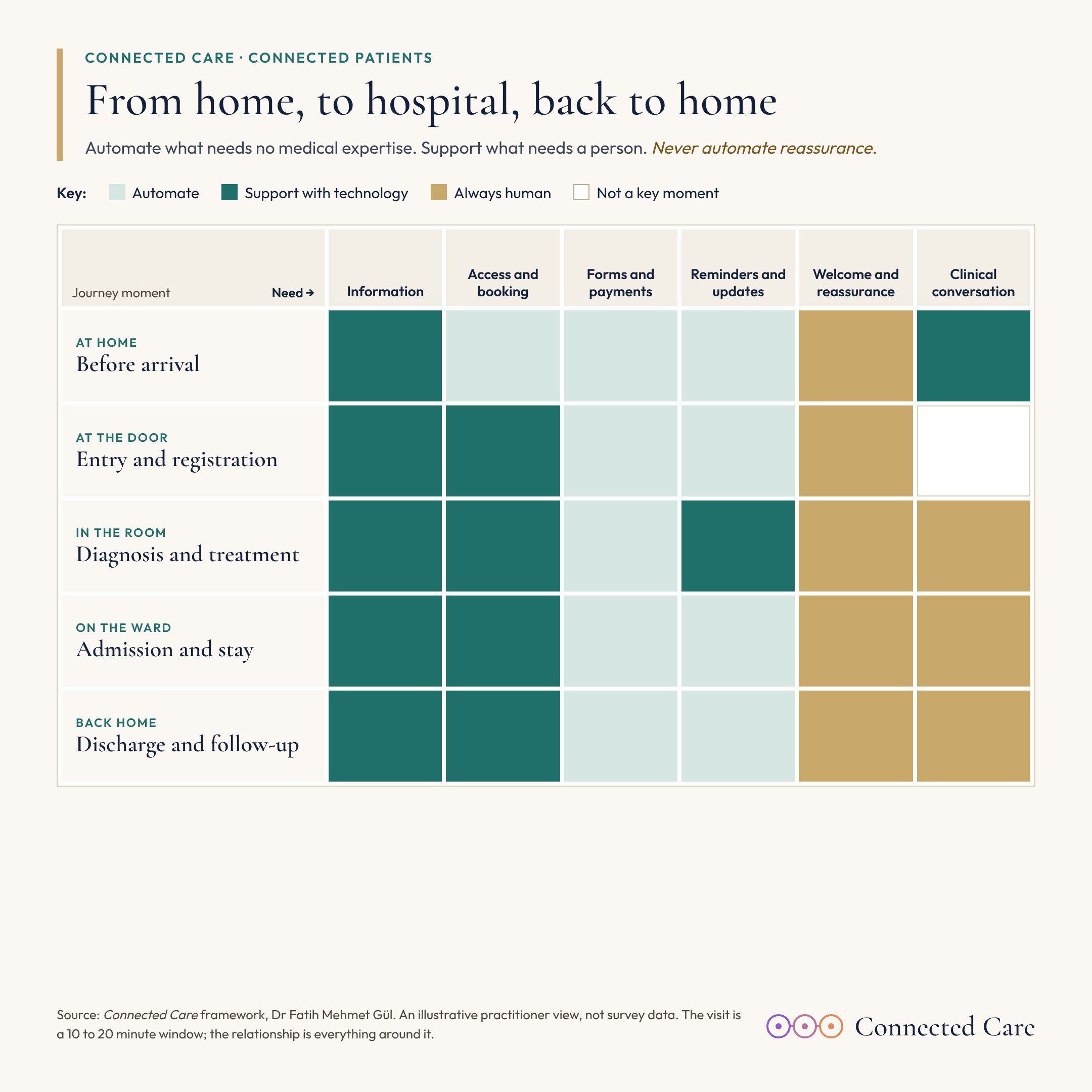
“There should always be a point where this AI solution should let the individual talk to an individual. We should never close all the doors of human interaction, otherwise this hospital would be left to a certain software and people will be limited within the software’s communication limits.”
Five rules before you switch anything on
- A person within sight of every machine and every screen.
- Where emotion is high, the software is a choice, never the only door.
- No software stands as a gate before care.
- Information travels, so the patient does not have to repeat it.
- Time saved by technology is reinvested in people, by decision.
The digital floor has no owner
The physical floor of a hospital has an architect, a project team and a commissioning plan. The digital floor has none. Digital transformation is not an IT project. IT's job is to install, and once it is installed, the job is done for them. Someone has to own the human touch, and that is a leadership challenge. In my view the rightful owners are the caregivers, because nobody knows the flow better than they do.
The five connections of Connected Care give us the goal: connected self, connected teams, connected patients, connected leadership and connected community. The free Human Touch Assessment and the other tools give a team a place to start on Monday.
Today we discuss AI. Tomorrow it will be something else. Technology will keep evolving. The relationship at the centre stays the same.
A big thank you to Jason Wolf and The Beryl Institute for the invitation, and to Becky Reisinger for her guidance and for hosting so smoothly on the day.
Based on my Headliner webinar for The Beryl Institute, 24 November 2026.