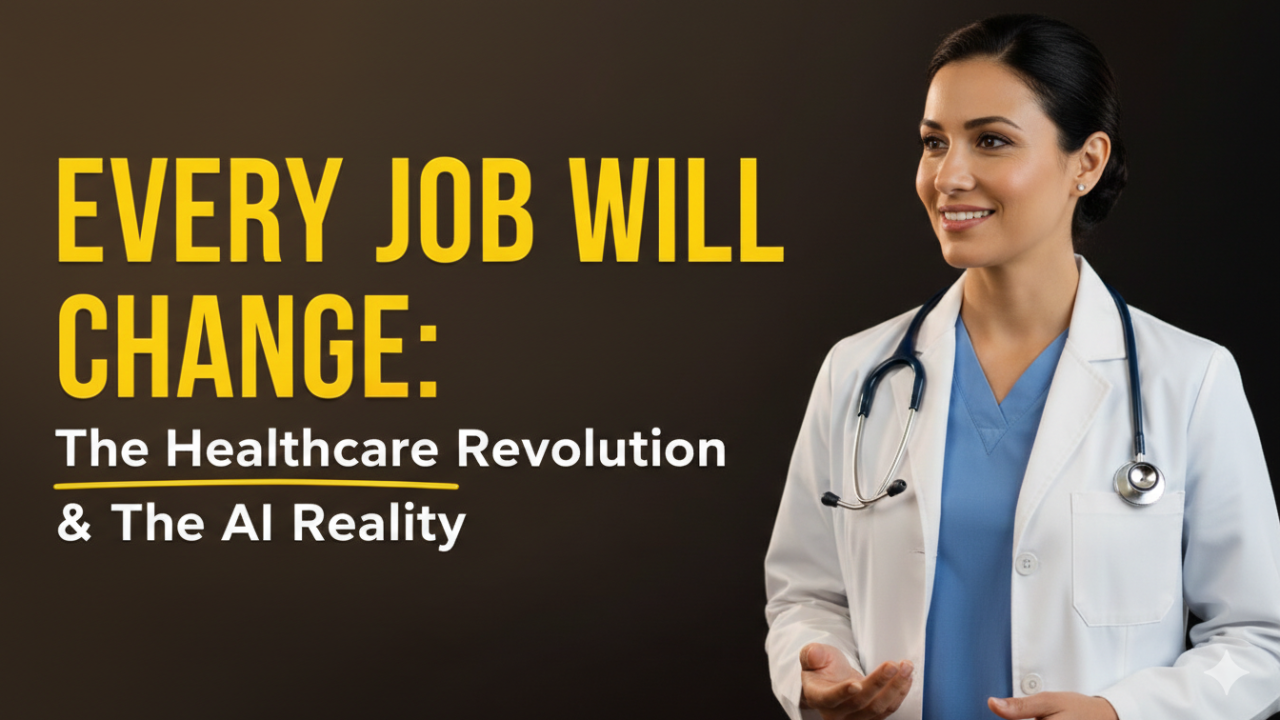
As the legendary business advisor Ram Charan bluntly states in his recent discussion on the future of work: "Everyone's job will change... confront that reality." This isn't just a warning for Silicon Valley; it is a siren call for the healthcare industry. Whether you are a Chief Medical Officer, a pharmacist, or a frontline nurse, your role is not just evolving—it is being fundamentally rewritten.
There are no two ways about it: Learn how your job will change, or it will be eliminated.
In this new era of 2026 healthcare, "quality of work" is the only metric that matters. We are shifting from a system of "sick care" to "high-precision wellness." Here is how the specific pillars of the medical ecosystem are being disrupted and what you must do to master the transition.
1. Physicians: From "Walking Encyclopedias" to Strategic Leaders
For a century, a physician's value was their diagnostic memory. Ram Charan notes that AI allows us to "think better, faster". For doctors, this means the end of rote diagnosis.
- The Change: AI models now outperform humans in synthesizing vast medical literatures and patient histories to identify rare diseases.
- The New Reality: Physicians are becoming Clinical Orchestrators. Their job is to leverage AI to "make better decisions" while managing the human elements AI cannot touch: medical ethics, end-of-life care, and complex surgical intuition.
- The Shift: If you are a doctor, your "self-confidence" must now come from your ability to manage an AI-integrated care team, not from having all the answers memorized.
2. Nurses: The Rise of Clinical Intelligence
Nursing has long been plagued by "grunt work." Ram’s vision suggests we must use AI to "have a lot of work done in less time".
- The Change: From automated vitals monitoring to AI-driven triage, the "paperwork" of nursing is evaporating.
- The New Reality: Nurses are moving into High-Acuity Oversight. With AI flagging patient deterioration hours before symptoms manifest, nurses act as "Rapid Responders" who intervene early. They are shifting from task-completion to clinical strategy.
3. Pharmacists: Beyond the Prescription Bottle
If your job is moving pills from a large bottle to a small bottle, Ram’s warning applies directly: that job is being eliminated.
- The Change: Robotics and AI-driven dispensaries are now the standard for accuracy and speed.
- The New Reality: Pharmacists are transitioning into Pharmacogenomics Specialists. They use AI to analyze a patient’s DNA to ensure a drug is biologically compatible. They are no longer "dispensers"; they are "biochemical consultants."
4. Technicians: Mastering the Digital Image
Radiology and lab technicians are at the epicenter of the "Master the application of AI" mandate.
- The Change: AI can now scan thousands of slides or images in seconds, highlighting anomalies that the human eye might miss.
- The New Reality: Technicians are now AI Data Validators. Your value is no longer in "taking the picture," but in ensuring the AI is calibrated correctly and interpreting the "quality of work" the machine produces.
5. Hospital Operations: The "Air Traffic Control" Model
Hospital administration and middle management must "confront the reality" that logistics are now algorithmic.
- The Change: AI predicts patient surges and staffing shortages days in advance.
- The New Reality: Hospital operations are becoming Predictive Systems. Management no longer reacts to crises; they oversee a self-correcting logistical engine.
6. The Hospital of 2026: Beyond the Building
Perhaps the most radical change is that the hospital is no longer just a building. It is becoming a Community Hub, connected to the people it serves 24/7.
- The Change: Hospitals are "staying in touch" through wearable IoT and ambient AI. They aren't places you visit only when you're broken; they are part of the community fabric.
- The New Reality: Hospitals are now "living the same occasions" as the community—partnering with local gyms, grocery stores, and schools to manage health in real-time. By the time you walk through the physical doors, the hospital already knows your data history from the last six months. The facility is merely the "surgical hub" for an expansive, invisible network of care that lives where you live.
How to Survive the Healthcare AI Shift (SEO Checklist)
If you are looking to "build your life" in this new landscape, follow Ram Charan’s roadmap:
- Upskill in Medical AI: Don't just use the tools; understand the logic. Master "the application of AI" in your specific niche.
- Focus on Soft Skills: Empathy, bedside manner, and ethical judgment are the "human-only" tasks that AI cannot replicate.
- Take a Step Back to Leap Forward: You might need to "go to school" or take a horizontal role in a tech-forward clinic to gain the necessary experience.
- Embrace Productivity: Use AI to handle the "lot of work" so you can focus on the "quality of work."
The Bottom Line
Many healthcare professionals are in their 30s—you have a "70-year future" ahead of you. The "juice of life" is in learning and mastering this new reality. Make the resolution today: don't just watch the change—lead it.
Based on the insights of Ram Charan and the evolving landscape of 2026 Medical Technology.
Business Advisor Ram Charan on AI and the Future of Work
This video features Ram Charan explaining why every professional must confront the reality of AI-driven change to stay relevant in their career.