
In business psychology, there’s a concept called “The Curse of Intelligence.” It describes how brilliant minds, by virtue of their expertise, often jump straight to a solution without first taking the time to deeply understand the problem.
Nowhere is this more dangerous than in healthcare. Our field is filled with brilliant clinicians, innovators, and executives. Yet healthcare is also littered with expensive, well-intentioned technologies that failed to deliver—not because they weren’t advanced, but because they weren’t human.
This is where Connected Care comes in: the reminder that healthcare technology succeeds only when it strengthens the bond between caregivers and patients, rather than replacing it.
I was reminded of this lesson by a story from my own experience.
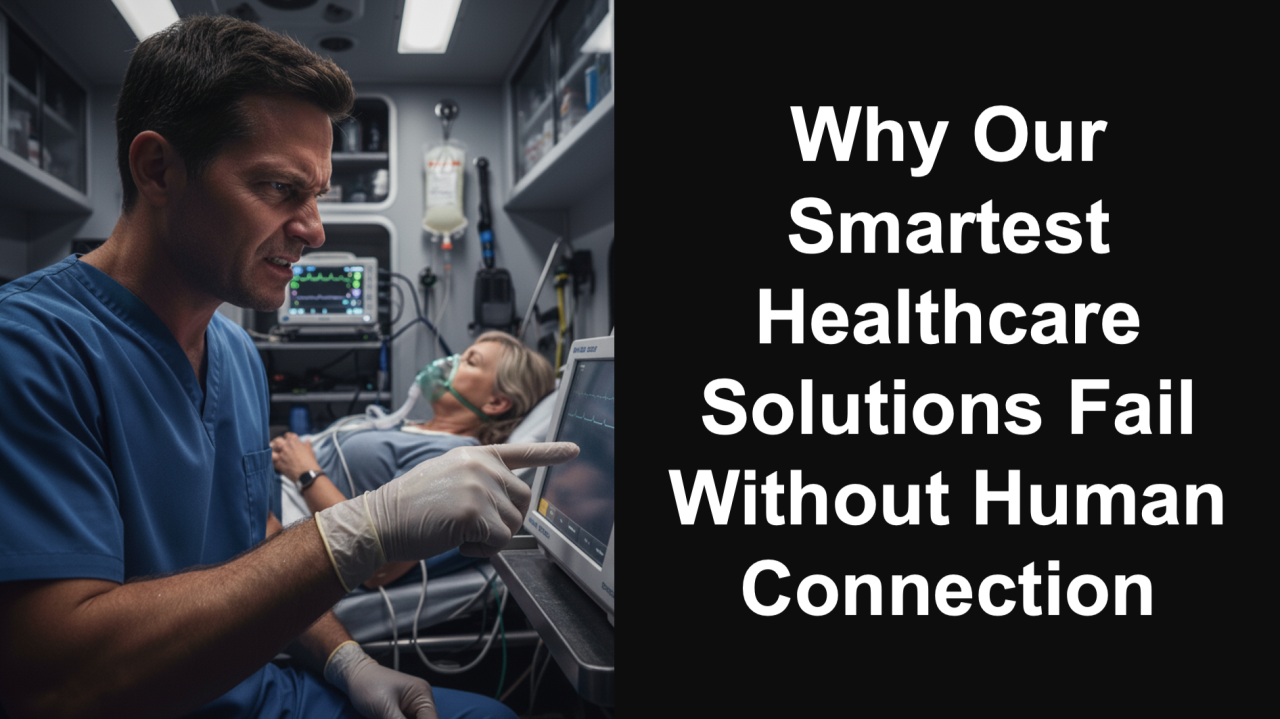
A company, eager to innovate, replaced the physical buttons on its defibrillator machines with a sleek touchscreen. The goal was simple: create a modern, best-in-class device. But no one stopped to ask the people who would actually use it.
In an emergency—when a doctor’s hands are wet, gloved, or covered in fluids—a touchscreen is useless. The product failed, and the company had to revert to the old design.
The engineers had solved a technological problem (“how can we make this device more advanced?”) but completely missed the human problem (“what does a clinician actually need when a life hangs in the balance?”).
Sadly, this story isn’t unique. Studies suggest that up to 70% of healthcare IT projects fail. The root cause is almost always the same: a failure to design with the end-user at the center.
Connected Care is the mindset shift healthcare urgently needs.
It’s not just about digital transformation—it’s about ensuring that every innovation amplifies human touch, empathy, and engagement. In this model, technology is not the hero; it is the enabler.
Connected Care means asking, “Does this tool create more space for healing and connection?” If the answer is no, then it’s not truly innovation.
The solution to the Curse of Intelligence is to be more connected, engaged, and curious.
The next time you’re presented with a new technology, ask the hard questions:
Because in healthcare, brilliance is not measured by how advanced our devices are, but by how much healing and humanity they enable.

The Home of Connected Care. Technology with Human Touch — the definitive framework for digital health transformation.
